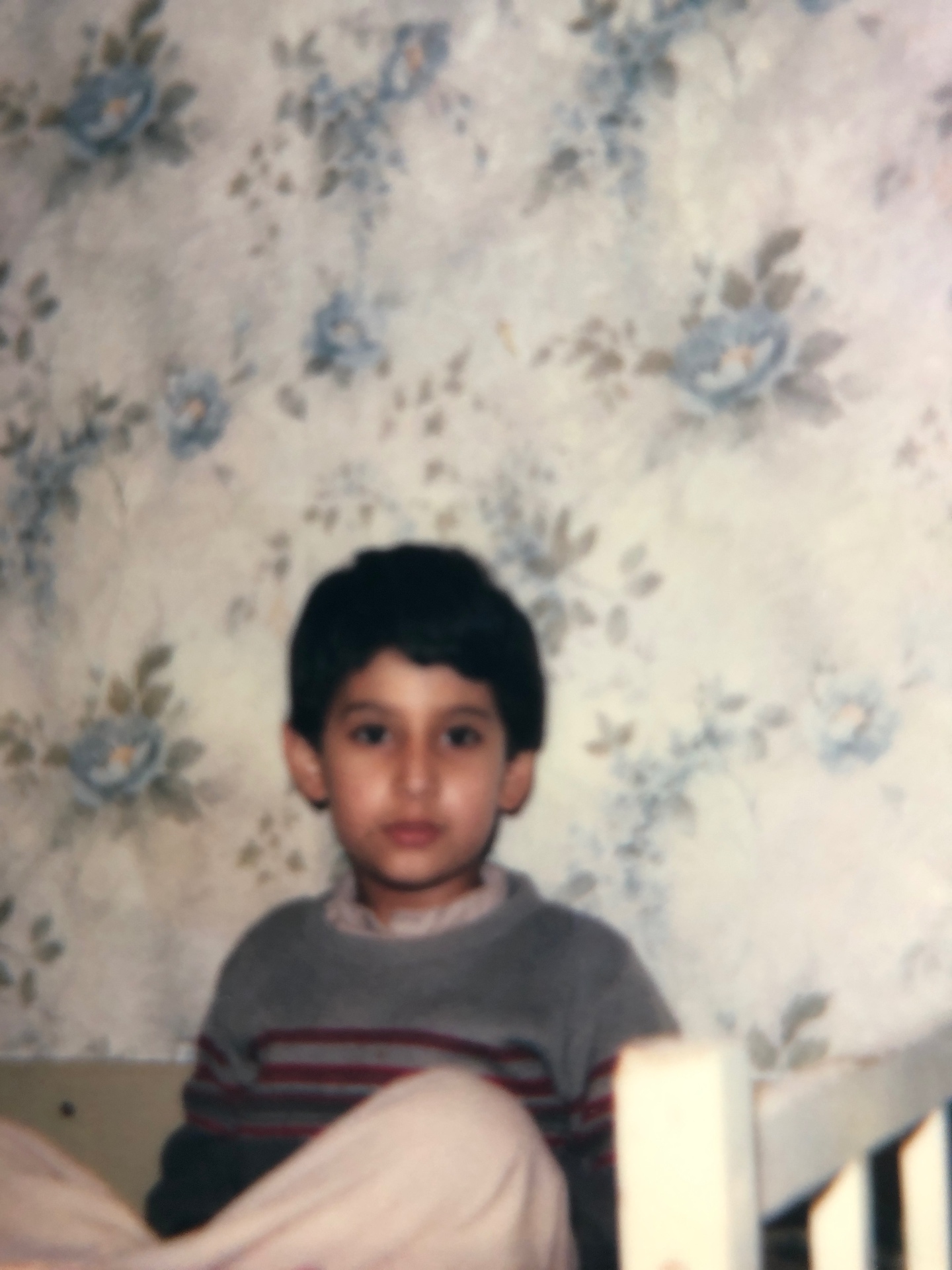
The Day the Boy Froze
In the late 1970s, my parents left everything and everyone they knew and loved, and moved to England.
My parents didn't really have a plan, or connections here, or even money to begin their new life. I think they just had hope and a desire for a better life for themselves and their unborn children.
My father was an automobile engineer and he found work at the Ford Motor Company. My mother was a teacher and she found work locally at a college. They were hardworking and determined to build a good life, a better life for their children than they had experienced themselves.
Some years later, in 1980, they had me, and my younger brother followed a few years after. We lived in a tiny two-bedroom rented flat in Hackney, East London. The smell of my mum's cooking wafted throughout the entire flat, and I remember the walls being so thin that you could hear the kettle boiling from our neighbours next door. It wasn't luxurious, but it was home, and it was full, full of school runs and bedtime routines, laughter and play between my brother and me.
It was a simple and ordinary life, but a complete one. One that you perhaps don't know is wholesome until it's gone.
Things were progressing and we had just moved into slightly larger accommodation, a small house in a nicer location.
And soon after, when I was seven years old, my father was injured at work. I don't know the details, but his right hand was badly damaged by some machinery at the factory. I remember the horror of seeing him coming home with stitches that ran all the way from the bottom of his palm up to his fingers.
It turned out that he had significant nerve damage so could no longer work, and so he was made redundant from Ford.
He sat at home frustrated at not being able to work. A small amount of pension money came through, weekly giros that were barely enough for us to get by. Suddenly, the man that was building things for others could no longer continue to build the life for his family that he had once prayed for.
I don't remember much, but I could sense his mood gradually change. The weight of having to provide for your family and not being able to must have been immense, perhaps shame, perhaps guilt. Looking back, there wasn't a language for what was happening, but from what I know now, his mental health was declining, and I'm sure he was depressed. You could see it in his eyes.
To cope, he began to smoke. Obsessively. Between sixty and eighty cigarettes a day. Yes, unfortunately this is not a typo. He became a chain smoker. And if you're blessed to not have seen this, it's someone that you do not see without a cigarette in their hand, from morning til they sleep, yellow-stained fingertips, consistently smelling of that horrible smell of smoke, no matter how much he would have tried to hide it.
Looking back, I don't think he was addicted to smoking. I think he was trying to disappear, trying to numb the pain, addicted to escaping his reality if anything.
I don't have many memories of that time, but I do still vividly remember the brand. Rothmans. Those white and blue cartons.
We had dozens and dozens of these empty cartons that were kept, so that my brother and I could take them and build elaborate structures on the living room carpet. Sometimes we'd use cartons to build the sides of roads and other cartons would be the cars driving through them. Sometimes we'd build great towers that would reach higher than us. And other times, we'd line them up carefully, creating patterns and towers, adjusting the spacing like little engineers, and then we'd flick the first one and watch them all fall down.
It was actually quite fun. We laughed every time we played with them. But at that time, as seven and four-year-old children, we didn't realise that we were playing with little pieces of my father's breakdown.
The medical issues with my father came in waves, each one worse than the last.
I think it started with high blood pressure and then breathing problems. Then one day there was the first heart attack, a shock to all of us. And then another heart attack, strokes, eventual bypass surgery.
His body was deteriorating, possibly as fast as his mind was. It was like his body had to deal with too many fires that the doctors kept trying to put out, but new ones kept starting.
I remember night after night, emergency after emergency, my mum dialling 999 at 1am, 2am, or 3am in the early hours of the night, once sometimes twice per week. Sometimes if my mum was caught trying to help my father as he struggled to breathe, she would call out to me to dial 999. I remember that 80s green wired telephone, every time that round dial spun, it felt like we were winding up for another night of waiting and hoping.
The paramedics would rush my father to hospital in the back of an ambulance, sirens on with their blue lights flashing, sometimes with my mother, my younger brother and me at the back with him, sometimes in a taxi behind the ambulance. We had done this so often that we knew what to grab before we left home: blankets because the waiting was always so cold, and some snacks because we wouldn't be able to buy anything from the vending machines.
The entrance of Newham General Hospital became all too familiar. The sterile corridors, the smell of the wards, the sadness of patients and their loved ones, the beeping of the machines, the stress of the medical staff, it felt like an airport for souls travelling in and out of this world.
We'd often spend the night at the hospital, hardly slept, and the next morning we'd be at our primary school. I don't think anyone knew what we were experiencing. We never spoke about it, and we got quite good at pretending, wearing a face that said everything was fine even though it felt like things were falling apart.
My mother, bless her, she held it all together, primarily for us I'm sure. She never let us see her struggle, or ever asked us to carry her burden. But in some rare moments, when she thought no one was looking, I could see the exhaustion and worry in her. She was also crumbling on the inside, but there was no 999 service for this. Not for her.
By now I was nine years old, and watching my father deteriorate and my mum struggle and carry the load for us all, I think somewhere in my subconscious I was forming a decision without being aware of it. And that was that I wouldn't add to my mother's load. I would just handle it alone. I learnt from the best. I learnt from my mother. This was my first lesson in suppression, and I was an excellent student.
By this stage, the doctors had said that there wasn't much more they could do for my father and this was now close to the end of his life. Words that you hear, but the brain can't or refuses to comprehend.
My mother had now converted the downstairs living room into his bedroom, as he couldn't go up and down the stairs anymore, and he'd be closer to the kitchen. There was now a single bed where the sofa used to be. Our living room had become the hospital room. There was a machine, an NHS walking stick, pill bottles on every surface, and that ever-present smell of illness that never quite left.
My father's illness progressively worsened, and eventually his kidneys began to fail. The doctors told him he would need a transplant, but there was a condition. He had to stop smoking completely. They can't give you new kidneys if you're still doing the thing that's destroying you.
I think he tried, I really do. He got down from sixty to eighty cigarettes a day to just three.
Three cigarettes.
For a man who had been chain smoking for years, who had used cigarettes as his escape from everything he couldn't face, getting down to three must have taken everything he had.
But it wasn't enough.
Three was still more than zero. And zero was what they needed.
So the transplant never happened. And the doctors explained to my mother what this meant. Among many things, it meant that his kidneys were unable to process water like they used to be able to. Hence, my father was permitted to have just half a glass of water per day. Yep, this again is not a typo, just half a glass of water daily, that had to be rationed by my mother. Any more and his kidneys would be overloaded and fail even faster than they already were.
How does a man survive twenty-four hours on half a glass?
Well, he doesn't. I remember him being so thirsty, his lips cracking because they were so dry, his throat would burn, and he could barely speak by now. But he would have to find the strength to call out when he was thirsty.
"Yousuf?" he would call out.
It would often start with a faint struggle to call out. Very faintly would I hear my name, not really knowing if my dad was calling, but then it would get louder.
"Yousuf, Yousuf son, please come."
It wasn't even the words, but the sound and energy of desperation and pain and weakness.
I would go to him.
"Can you ask Mum for some water please?"
He would ask me knowing my mother could either not hear him from down the corridor, or that she wouldn't be able to give him more water.
I wanted so, so desperately to help him, to be able to get him a whole jug of water, to give him some relief.
I would walk down the corridor to the kitchen where my mother would be, often at the sink, doing the dishes, curved back, silently carrying this weight.
"Mummy," I'd say. "Dad wants some more water."
She wouldn't even turn around. And I would know all too well what the answer would be each time.
"Son, you know I can't give him more."
That's all. Seven words that I would hear each time, every time my dad asked me. I can't imagine what she would go through, having to say no to her child wanting water for his father, with her dying husband in the room down the corridor.
All I understood at that time was that I'd have to walk back down that corridor, look at him, at his eyes, and deliver the worst possible news to my father, having to say no when he was hoping desperately for a yes.
"Mum says she can't."
Countless times a day, I would deliver this disappointment to my father, over and over and over again, each and every day.
I felt helpless. I felt hopeless.
During the week, there was school, somewhere to go, something to take my mind off things. A few hours where life could feel somewhat normal.
But weekends, we were at home all day. And these were the worst.
I would have the entire day of my father calling me again and again, and the cycle of walking to my mum and back again empty-handed would continue.
Eventually, I stopped going down. I think I was escaping from what I would have to deal with and feel. So I'd sit at the top of the stairs, on exactly the all-too-familiar step thirteen. And spend hours just staring at the maroon patterned carpet with brown and red swirls.
As my hand gripped the banister, I would listen to my father call my name, over and over again, but I wouldn't answer or go down. I couldn't go down to deal with things, but I couldn't go to my room to hide away either, as there was a possibility my younger brother would hear my father and go to him.
So I just sat there.
Frozen.
I couldn't go down and I couldn't hide.
I'd just sit there and wait for it to be over.
Then came the day that everything stopped.
It was around 1pm on Saturday, 25th of July, 1992.
I was eleven years old by now and my brother was just eight, and we were at a sort of summer class at our school.
My father had some type of stroke, and for some reason my mother couldn't accompany him to the hospital this time. And a short while later, the hospital called: "It doesn't look good, you should come as soon as you can," they said.
My mum rushed to the school to collect us both. I remember the teacher coming into our class in a panic and asking us to leave in a hurry. I remember the long taxi ride, and the driver driving so slowly, and my mother's worried voice, "Please drive faster, my husband is in hospital." But I don't remember the driver driving any faster.
We got to the hospital and found the emergency care room where he was in.
But it was too late. He was gone.
I remember my mum broke into tears and pleaded with him: "Please, please wake up. If not for me, then for these children, please, please." She banged his chest over and over again with her fists as she repeated these lines.
But of course, he didn't move. He didn't wake up. He couldn't. He was actually gone.
I touched his hands, but I was startled at how cold they already were, so I pulled mine away instantly.
It's hard to describe how I felt, because the easiest way to say it is, I felt... nothing. But at the same time, I felt confused. I think I felt the weight of the unknown time and place we had found ourselves in. I felt the temperature of the room, it was cold. I felt frozen, still. I felt nothing.
There were no tears, no sadness or emotion, no pain. Just stillness and absence I couldn't articulate or begin to explain.
I don't remember sleeping that night.
And the next day, the people from the funeral home brought his body to our home in a coffin.
I had heard the knock on the door earlier, but didn't realise this was happening. The funeral men had walked back out to their cars to perhaps unload something, while I accidentally discovered my father's coffin that had been placed in the living room. The same room where he had spent his final months, which for me still echoed him calling my name pleading for some water. The room that I had learnt to avoid and block out of my mind.
I stood in this living room, just him and me.
I don't know how, but the living room felt empty and full at the same time, and heavy and light at the same time.
The coffin was simple, wooden and functional. This was the first time I had seen one. My father was wrapped in a white cloth, only his face was visible.
He looked smaller than I remembered, somehow quieter.
I remember I stood there, not knowing what to do or say.
I felt I should say something, but I didn't. I don't think I knew what to say, or how.
I remember feeling there was a part of me that wanted to say:
Daddy, I love you.
I'm sorry I couldn't give you more water.
I'm sorry I stopped coming to you.
I'm sorry, Dad.
But the words wouldn't come out.
I think I had been practising silence for years, on the stairs, in the kitchen, walking back and forth, back and forth, carrying words I couldn't speak and feelings I couldn't feel. And now, when it mattered most, silence was all I had left.
I heard footsteps returning and voices in the hallway, and so this moment was ending, and I walked away from that coffin having missed this opportunity.
At the burial site, my father's coffin was laid next to the six-foot hole that had been dug for him. The lid was about to close. Someone said out loud to me:
"Say something to your father. It's the last time you'll see him."
These words sat deeply. But I couldn't speak.
And even though many people at the funeral were crying, quite possibly out of sympathy for our family, I couldn't cry.
I just stood there, watching the lid close.
The prayers were read and the coffin was lowered into the ground, and the dirt covered the hole that was once empty.
I walked away from that gravesite, having not said anything, and having not shed a tear.
And I wasn't going to anytime soon. Whatever was happening inside of me, it wasn't going to come out. I would just lock it in tighter.
A month later I had to start secondary school and my brother was still in primary, but we both struggled. Not because we weren't smart, but because Shakespeare and trigonometry didn't make sense to us. Not to the lives we had been living. No one teaches you how to grieve. No one teaches you what to do when bailiffs knock on your door or how to watch your mother struggle. The curriculum had nothing for that.
Somehow the word had got out that our father had passed away. And children can be mean. We were the children with the dead father, and so we both got bullied. But we didn't speak of it to anyone, just swallowed it as part of life. Our life.
And financially things had become even tighter for my mother. She was doing everything she could. The pension barely covered food, the bills piled up, and the letters came with red writing on them. I'd discover them in the drawer where she thought we wouldn't see.
I remember once the council tax couldn't be paid, and so we had a knock on the door from the bailiffs.
I pray you've never had this misfortune. They have a particular kind of knock, one where you know they know you're inside, and soon they will enter your house whether you like it or not.
This time there were two men in black suits. I had opened the door, and one of them put his big black boot in the doorway so it couldn't close, and the other was already looking past me into the house, his eyes scanning our belongings like he was pricing them.
They wanted money we didn't have, and when they couldn't get money, they wanted things. They walked through our home, pointing at objects, the old television, the microwave, and then the PlayStation.
You have to understand what that PlayStation meant to us. It wasn't just a toy. It was the only thing my brother and I had that let us be kids for an hour at a time. The only thing that, when we played, allowed us to forget that we weren't the "dead dad" kids. We weren't the boys who couldn't afford new shoes, or the family that everyone looked at with pity. We were just two brothers, trying to beat a level at Mario Kart, arguing about whose turn it was, being normal.
One of the bailiffs unplugged the PlayStation and started to pack it to take away, and my mum said something I'll never forget.
"Please," she said. "Take anything else. Take my wedding jewellery. But please don't take that. That's all they have."
I stood there in the hallway, frozen. The same freeze that had taken hold on the stairs.
A couple of months after the funeral, something unbelievable was about to happen. Something that I have only very recently started to talk about.
There was a knock at the front door.
I could see a shape through the frosted glass as I walked down the hallway. It seemed familiar, in a way I couldn't explain, but I remember it made my heart beat faster the closer to the door I got.
I opened the door.
And there he was.
My father.
My actual father was standing there. At the doorstep. Alive.
What? How was this possible?
I cannot explain the confusion and shock. These words cannot come close to what was happening in my mind and body.
I moved even closer to double check, and yes, it was my father. He looked healthy, a version of him that I barely remembered. He looked strong with warm eyes, and a smile on his face that said "I'll explain later, just come here."
I didn't waste a second trying to understand how this was possible. I just ran into his arms.
I held him so tightly I had to stop breathing for a moment, and I thought I might actually break something. I could feel his chest rise and fall beneath my cheek. I could smell him, that familiar scent I'd forgotten I remembered, this time without the smell of a sick person, and without the layers of cigarette smoke.
My mother and my brother came and were shocked beyond comprehension. They didn't understand this either, but we all just hugged my father so tightly as he enveloped us with his arms.
It didn't even matter what had happened, how this was possible. In that moment, all that mattered was that he was back, and everything was going to be okay.
And then I woke up.
It was just a dream. Or a nightmare. I still don't know which one.
As I sat up in the dark, looking at my bedroom wall, with my heart racing, I can't begin to explain the cold, crushing realisation that it wasn't real. I felt I had just lost him all over again. I was absolutely devastated.
I'm not exaggerating when I say this happened to me almost every night. I was eleven years old the first time it happened. I was fourteen when it finally stopped. A thousand nights, give or take. A thousand times I got him back. A thousand times I lost him again.
Each time it felt real, and each time I woke to devastation and heartbreak.
I never told anyone.
I started listening to LBC radio every night through my head to delay my sleep for as long as possible. Talk shows, phone-ins, debates about things I didn't care about, it didn't really matter what it was, as long as it kept me awake.
I dreaded sleep, because sleep meant dreaming, and dreaming meant losing him again.
Eventually, the dreams stopped. By fourteen, they were gone. All and any types of dreams were gone. But I had learnt my lesson:
Don't let yourself believe that good things can happen, because the moment you believe it, the moment you let yourself feel joy... it will be taken away.
Years passed, and I grew up. I finished school, went to university, started building a life. From the outside, things looked like they were moving forward.
But something had changed in me during those years on the stairs, during those nights of losing my father over and over again. Something had shut down.
My mother, the woman who had held our family together through the worst years of our lives, who had stood at that kitchen sink refusing to give my father water because she loved him too much to let him die faster, who had offered her wedding jewellery to bailiffs to protect a PlayStation because she understood what her sons needed, I couldn't let her in.
I'd visit her. I'd sit in her kitchen. I'd drink the tea she made and answer the questions she asked. But I was never really there. There was always a part of me standing back, watching the interaction from a distance, making sure I didn't feel too much, didn't need too much.
She'd ask how I was doing. Fine, I'd say. Good. Busy.
She knew. Of course she knew. Mothers always know. But I think she'd learned not to push, maybe she was afraid of what she'd find if she did. Maybe she was just grateful I was still showing up at all.
My brother, the only other person on the planet who knew what it was like to grow up in that house, to play with those cigarette cartons, to be the dead dad kids, we barely talked about anything real. We'd meet, we'd chat, we'd circle around the surface of each other's lives without ever landing. There was something between us, thick and invisible, that neither of us knew how to name or break through.
Friends came and went. I was good at the beginning of friendships, charming, interested, present enough to make a connection. But the moment things got deeper, the moment someone started asking real questions or expecting real answers, I'd feel that familiar pull. The retreat. The distance opening up.
And romantic relationships, they were the hardest. Because intimacy requires vulnerability, and vulnerability requires presence. And presence was the one thing I couldn't give.
It felt like there was a piece of glass, an invisible barrier, a layer of separation between me and everything else.
I used to tell myself I was just calm, and measured. But that wasn't true, I was just numb.
When I was finishing school, people said I should study medicine and become a doctor.
But I had spent years watching doctors. I had seen them try everything, and I had seen them fail. Despite all their knowledge, all their technology, all their training, they couldn't save my father. And I didn't want to be that. I didn't want to spend my life treating symptoms while the root stayed untouched.
I knew there was something deeper. Something they weren't seeing. Something about the mind, about patterns, about why people do the things they do even when those things are destroying them.
Why couldn't my father stop smoking, even when his life depended on it? Why couldn't I cry at his funeral, even when I wanted to? Why couldn't I feel close to the people I loved, even when I tried?
So I went to university and studied cognitive sciences. I was fascinated by the brain, by neuroscience, by psychoimmunology, by the connection between what we think and feel and what happens in our bodies. I wanted to understand the machinery that was running beneath the surface of human behaviour.
I didn't know it then, but I was looking for something. Looking for the answer to a question I couldn't yet articulate.
What was wrong with me? And could it be fixed?
After university, I did what numb people do.
I worked.
Give me a problem to solve, a system to build, a goal to chase, and I could lose myself in it completely. Hours would pass, days, weeks, often months. I'd look up from my desk and realise the sun had set without me noticing. I'd forget to eat, forget to call people back, forget that there was a world outside the tasks in front of me. The tasks and projects never stopped coming.
Some people called it dedication, drive, work ethic. I was even praised for it.
I built things. Many organisations. Education centres across London, spaces designed for children who were struggling in school. The ones with learning differences, emotional blocks, invisible barriers. The ones falling through the cracks.
There were kids who couldn't focus because their minds were somewhere else. Kids who were called disruptive when they were actually just surviving. Kids who needed someone to see past their behaviour to the pain beneath.
I trained teachers to see those kids. Hundreds of teachers, over seven years, across five centres. I taught them that struggling doesn't mean broken. That sometimes the most difficult children are carrying the heaviest loads.
Then I created a publishing company. Comics that took the entire primary school curriculum and turned it into stories, visual, emotional, and accessible. We reached over 300,000 children. The comics were in Tesco, Sainsbury's, WH Smith. They were on national television.
And buried in those comics, I included sections on personal development. How to cope with bullying. How to ask for help. How to feel okay if you were different, or misunderstood, or simply didn't fit in.
From the outside, I was successful, building things, generating revenue, creating impact and being profiled in articles.
I didn't see it at the time. But I see it now.
Every struggling child who walked through our doors was a version of me. Every comic I wrote was a letter to the boy I used to be.
I was trying to save children because I couldn't save myself.
And there were other things too. Things I never connected to what had happened when I was young.
I was an overthinker. I could spend hours turning a simple decision over in my mind, paralysed by possibilities, unable to commit to anything because what if I got it wrong. Even small things, like what to order at a restaurant or what to reply to a message, could become exhausting mental exercises.
I was a people pleaser. I would say sorry for things I didn't do, apologise for existing, shrink myself to make others comfortable. I would agree with people I disagreed with, laugh at jokes that weren't funny, go along with plans I didn't want, just to avoid the possibility of conflict or rejection.
I felt insecure around confident people. I was 6'1 but didn't feel tall enough. I had nice brown skin, the kind people pay money to tan to achieve, but I felt like I was the wrong colour. I didn't like the way I looked, the way I sounded. I had self-doubt and uncertainty about everything.
I was making millions in revenue, growing teams, being profiled in articles. But it was hard. Everything felt hard. I was always operating from a place of survival, like I was running from something I couldn't name, like I was trying to prove something to someone but I didn't know who or what.
I had low energy. I didn't really want to do anything. I'd push through, achieve things, tick boxes, but there was no fire underneath it. Just discipline and fear.
I didn't know it then, but all of it was connected. All of it came from the same place. The boy who couldn't cry at his father's funeral had grown into a man who couldn't feel much of anything. The boy who froze on the stairs had grown into a man who froze in rooms full of opportunity. The boy who learned to suppress had grown into a man who didn't know how to do anything else.
I was successful. I was helping children. I was building things that mattered.
But I was still frozen. Still that boy on the stairs.
And I didn't know how to change it.